Date/Time
Date(s) - March 25, 2026
5:00 pm - 6:00 pm
Categories No Categories
Guest Lecture: Blade Redae, Ph.D
Postdoctoral Researcher, Institute of Human Origins, Arizona State University
“Tracking evidence of faunal exploitation by Plio-Pleistocene hominins in eastern Africa: New zooarchaeological data from the Lower Omo Valley”
Wednesday, March 25 | 5-6 pm
Behavioral Sciences 103
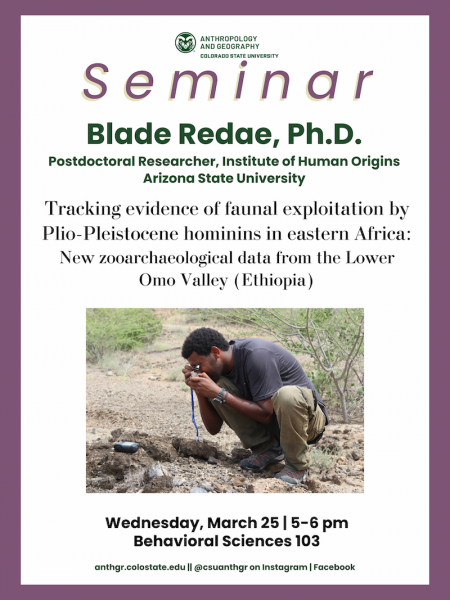
Abstract: The incorporation of animal resources into the hominin diet, facilitated by stone tools, is regarded as a key milestone in human evolution, linked to adaptive flexibility, brain development, and subsequent technological and cultural innovations. Direct evidence of faunal consumption comes from fossil bones with butchery marks (cut and/or percussion marks). However, such traces of butchery marks are extremely rare in the fossil record, especially those older than 2 Ma. Furthermore, such research in eastern Africa has been confined to just a few sites, with paleoanthropological efforts historically emphasizing the collection of complete specimens or those possessing diagnostic features crucial for taxonomic classification. While these approaches are useful for taxonomic and ecological reconstructions, they fall short in addressing questions about hominin subsistence behaviors, as most specimens with such evidence are often shaft fragments. This has made it difficult to reconstruct the origins and extent of stone tool use and to understand the role of hominins in the food web throughout the Pliocene-Pleistocene. Moreover, crocodilians and mammalian carnivores are frequently found in association with fossil assemblages, and their tooth marks can often be challenging to distinguish from butchery marks.
In this talk, I will present new taphonomic data from the Shungura Fm. (~3.75 Ma to ~1 Ma), a nearly continuous Plio-Pleistocene sequence with well-established chronology. The site provides one of the richest faunal collections, including hominins and their early behavioral records. A zooarchaeological study of Oldowan and new Acheulean occurrences was conducted for the first time, revealing evidence of butchery marks on a range of terrestrial and aquatic fauna. I will also discuss methods used for addressing equifinality challenges using confocal microscopy and 3D quantitative analysis.