Petersen-Perlman Brings Flood of Water Interests as New Geography Faculty
Josh Zaffos
September 2, 2025
Anyone who has studied and worked on water topics knows the adage, “Whiskey is for drinking, water is for…fighting.” Assistant Professor of Geography Jacob Petersen-Perlman who studies water conflict can’t argue that water is at the root of many tense interactions, but he also sees space and optimism for collaboration and cooperation in 21st century water management.
“Research [shows] with empirical data that the significant majority of interactions between countries were largely peaceful,” Petersen-Perlman said.
Since water is so essential for everything humans do, it is critical that we find ways to manage and govern water resources more effectively and justly.
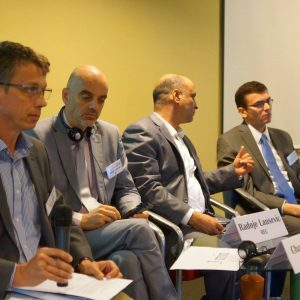
Petersen-Perlman joined the Department of Anthropology and Geography faculty in 2025, after previously teaching in the CSU Department of Ecosystem Science and Sustainability. A human-environment geographer, he studies the changing actions and relationships of political institutions and organizations that manage water resources while facing decreasing supplies, degraded water quality, and global environmental change. Petersen-Perlman uses qualitative, quantitative, and geospatial analysis to study water governance around the U.S. in Colorado, North Carolina, Oregon, and Arizona as well as Middle East-North Africa. He also co-organized and led “The Past and Future of Groundwater in the West,” a daylong symposium about groundwater management and governance in Colorado and the West at CSU in March 2025.
We spoke to Petersen-Perlman about his path into geography and plans for classes and research at CSU.
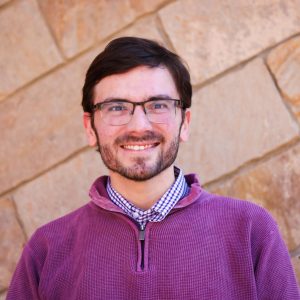
Welcome to CSU Anthropology and Geography!
I’m very happy to be here! I’ve been really fortunate to connect with Anthropology & Geography undergraduate majors in my classes already. They’ve been enthusiastic, curious, and hard-working!
What led you into geography and the topics you study?
I went into college thinking I was going to be a meteorologist. Though I still enjoy learning more about the nuances of weather and climate, I found that I was more passionate about understanding how humans respond to complex challenges involving the natural environment, specifically water. I remember hearing people say that water was going to be the new oil – meaning that water would be the major source of interstate conflict.
I later came across research that showed with empirical data that the significant majority of interactions between countries were largely peaceful. That’s not to say that water conflict doesn’t still exist, however. Since water is so essential for everything humans do, it is critical that we find ways to manage and govern water resources more effectively and justly.
Describe your major research topics or projects. How did you start investigating these topics?
My main research areas of focus include transboundary water conflict and cooperation, water governance, and disaster recovery. Among my current projects, I am continuing work on a project that I started while at East Carolina University. It involves disaster recovery and social capital in eastern North Carolina communities.
I’m also working with Matt Ross and Stephanie Kampf in Ecosystem Science & Sustainability, and the National Park Service on analyzing the water system vulnerability of National Park sites to future change.
Finally, I’ve just started a project with one of my graduate students, Jaque McVey, and Ryan Morrison in Civil & Environmental Engineering, focusing on identifying and implementing new instream flow methodologies in Colorado. The project is being funded by the Colorado Water Conservation Board.
What keeps you motivated to study water resources management?
I’m drawn to this topic because as the world gets hotter, wet places are going to get wetter, and drier places are going to get drier. This will also be followed by more extremes: more intense rainfalls and more prolonged droughts. Therefore, what decisions we make regarding our water resources really shape our future. There are plenty of examples of this across the world — the city of Tehran, Iran, is currently experiencing extreme water stress due in part to water mismanagement.
What have been some important takeaways from your work in terms of your own understanding of these matters? What about for the communities/places you work with?
I appreciate how universal the need for water is and therefore how difficult and challenging it is to find water management solutions. I find that, oftentimes, solutions do not reveal themselves until users are forced to offer them. I also appreciate how water user groups, or states, or countries, can find solutions to managing shared waters despite the fact that they don’t agree on anything else. Take India and Pakistan, for instance – the Indus Waters Treaty is still in effect despite multiple conflicts and wars.
What research projects do you hope to continue and launch at CSU?
In addition to ongoing projects, I am particularly keen on continuing research surrounding water issues here in Colorado and the American West. I would especially like to do more research on groundwater management and governance.
Are there courses you’re planning to develop, or that you’re looking forward to teach?
I’d like to eventually develop a course focusing on the field geography of Colorado. I’d also like to teach a course focused on negotiations over shared natural resources.